
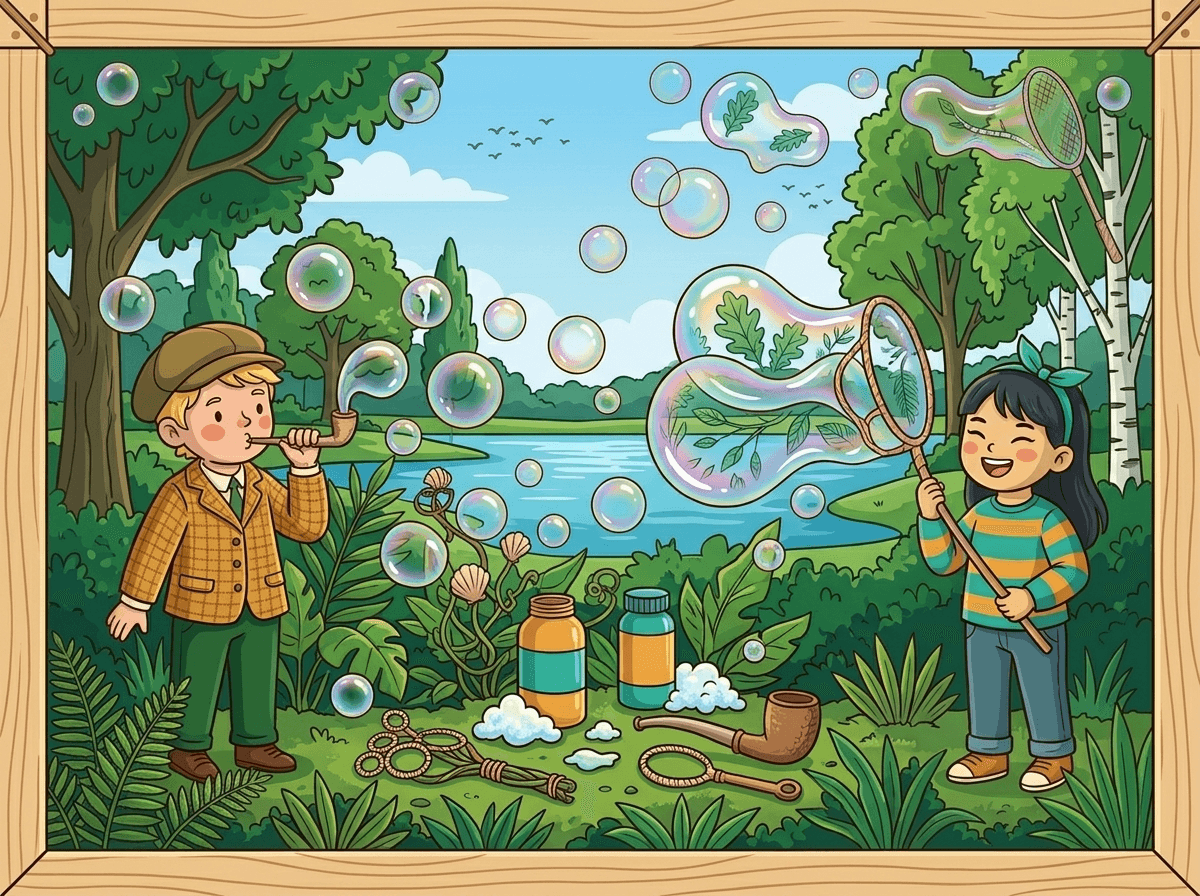
Children have been playing with soap bubbles for at least 400 years. As early as the 1600s, European paintings depicted children blowing bubbles through small clay pipes dipped in soapy water. One of the most celebrated examples is Jean-Siméon Chardin's Soap Bubbles (1733-1734), now at the Metropolitan Museum of Art, which shows a young man leaning from a window to blow a bubble while a smaller child watches in rapt fascination. The painting captures something every parent still recognises: the near-magical hold that a floating, iridescent sphere has over a young child's attention.
Bubble play wasn't limited to Europe. In Japan, traveling street vendors were selling bubble-making materials as early as the late 1600s - one of the earliest documented examples of a bubble toy being sold commercially anywhere in the world.
From Kitchen Bowl to Toy Store
For most of their history, bubbles required nothing more than soap, water, and a hollow pipe. It wasn't until 1940 that a Chicago cleaning-supplies company called Chemtoy began bottling bubble solution specifically for children, transforming a kitchen-table activity into something you could buy at a toy store. By the late 1940s, bottled bubbles were a staple at toy shops across the United States. Today, more than 200 million bottles of bubble solution are sold worldwide every year - making it one of the top-selling toy categories on earth.
Why Bubbles Are Good for Children
The appeal of bubbles is obvious, but the developmental benefits are less often discussed. Blowing a bubble requires controlled breath and focused effort. Chasing and popping bubbles builds hand-eye coordination and encourages physical movement. And watching a bubble float, shimmer, and pop is a natural introduction to cause-and-effect thinking - one of the earliest foundations of scientific reasoning. Researchers studying early childhood play have found that bubble activities tend to generate spontaneous questions and predictions in young children: Why is it round? Why does it change colour? What happens if I touch it? These are among the first moments of genuine inquiry.
The science is elegant, too. Pure water bubbles pop almost instantly because its molecules pull too tightly on one another. Soap disrupts those bonds just enough to let a thin, flexible film form and stretch. The shifting colours on a bubble's surface aren't pigment - they're light waves bouncing between the inner and outer layers of the soap film. Every bubble is a tiny physics demonstration, quietly happening in a child's hands.
A Toy Hall of Famer
In 2014, soap bubbles were inducted into the National Toy Hall of Fame at the Strong National Museum of Play - joining the cardboard box, the stick, and the blanket as one of the simplest and most enduring playthings in human history. Few toys have remained so inexpensive, so simple, and so universally loved - by children who have just learned to walk, and by grandparents who remember blowing them decades ago.